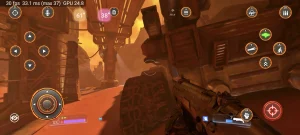
The Last of Us Remastered, one of PlayStation’s most well-known games, has received an unofficial APK port for Android. The first public version of the adaptation was made available on November 6, 2026, by Brazilian developer Erick Mendes, from the Daedalus Emulator project, and already allows running the Naughty Dog classic directly on high-performance smartphones.
The first tests are promising: a demonstration released with the RedMagic 10 Pro, equipped with Snapdragon 8 Elite, recorded around 36 FPS at 720p resolution. There are also reports from players mentioning results close to 30 FPS on the POCO F7, but it has not yet been possible to independently confirm the settings and stability of that test.
The result draws attention because we are not talking about streaming, remote access to a console, or an official version released by Sony. The project uses the original game files from the PlayStation 4 version and a compatibility layer adapted for Android.
Video from the Autoridade Tech channel:
The Last of Us Remastered for Android already has an APK available
The adaptation is called The Last of Us Remastered — Daedalus Android and reached its first public version, 0.1, on November 6. The work is based on the PC project by developer ravencaio, who created a custom environment to run the PlayStation 4 edition outside the console.
Erick Mendes used this base to build a version aimed at Android smartphones, with its own launcher, touch control support, graphics adjustments, and tools to prepare the game files on the phone itself.
It is important to highlight that the adaptation uses The Last of Us Remastered, released for PlayStation 4 in 2014. It is not the original PlayStation 3 game nor the remake The Last of Us Part I, initially released for PlayStation 5 in 2022 and later for PC.
This distinction is important because the PS4 Remastered edition uses a different technological base and has lower requirements than the more recent remake.
Port runs on Android, but does not use full ARM64 recompilation
The new project has been promoted among fans of ports and recompiled games, but its technology has an important difference compared to other recent adaptations.
The original PlayStation 4 game uses x86-64 processor code, while most modern Android phones use ARM64 processors. Therefore, it is not possible to run all the game’s instructions directly on the smartphone’s CPU without adaptation.
To solve this problem, Daedalus Android combines an ARM64 environment based on Bionic, Android’s system library, with FEX-Emu technology, responsible for translating x86-64 CPU instructions to ARM64 during execution.
On the graphics side, the project uses components derived from shadPS4 to adapt the game’s rendering to the Vulkan API. There is also support for Turnip graphics drivers on devices with Adreno GPUs.
This means that The Last of Us runs locally on Android, but it is not a fully native CPU port, like some static recompilations of older games or projects that take advantage of original ARM64 code from certain consoles.
Even so, the initiative is quite interesting, since the team managed to gather the necessary tools into a specific Android application for the game, without depending on a conventional Windows environment.
The Last of Us already reaches more than 30 FPS on a smartphone with Snapdragon
The main test reported by the international press used a RedMagic 10 Pro with Snapdragon 8 Elite and Adreno 830 GPU. On this device, the adaptation reached an average of approximately 36 frames per second at 720p.
The rate is already close to the 30 FPS experience offered by many console games, although the result still depends on the scenario and the settings used.
There are also reports of performance in the 30 FPS range on devices such as the POCO F7. However, we did not locate a documented test that would allow confirming whether this rate is maintained during gameplay on that model, nor which graphics adjustments were used.
Therefore, it is still too early to state that any phone equipped with a recent Snapdragon will be able to run the game stably.
The application offers several options to try to improve performance, including:
- Resolution: possibility to use the game’s original profile or reduce to 720p, 540p, and 360p;
- Frame limit: options of 30 or 60 FPS, with no guarantee of reaching these rates;
- Visual effects: adjustments for ambient occlusion, motion blur, depth of field, bloom, and shadows;
- Drivers: included Turnip versions and the possibility to import compatible drivers;
- Monitoring: display of FPS and CPU and GPU information during the match;
- Controls: virtual commands and support for physical gamepads.
60 FPS support only means that the player can select this limit. It is not an indication that the smartphone can maintain this rate during the campaign.
Adaptation allows playing with touch controls or gamepad
One of the most interesting novelties of this first version is the interface prepared for phones.
Daedalus Android includes virtual controls and offers support for physical controllers, allowing play with compatible Bluetooth or USB accessories. It is also possible to change the way the game occupies the smartphone screen.
During the match, the user can open a menu by sliding a finger from the left edge. In it, it is possible to access graphics adjustments and other execution options.
The application also allows importing and exporting progress files in ZIP, as well as selecting saved games when the necessary data is available.
The launcher interface features Brazilian Portuguese and nine other languages. The game language, however, must be configured in the title’s own options, according to the files of the edition used.
Port still has graphical problems and crashes
Despite the encouraging results, the release is experimental. The developer has not confirmed that the entire The Last of Us Remastered campaign can be completed on Android without errors.
Among the known problems are pauses caused by shader compilation, specific physics and collision failures, and possible crashes in certain scenes.
One of the recent fixes was created to deal with character deformations caused by physics result synchronization. Another change attempts to prevent an access error to the geometry of certain scenery objects.
These improvements show that the project is already advancing, but they also make clear that it is still far from being a commercial release ready for any device.
How to download The Last of Us Remastered APK for Android?
Version 0.1 of Daedalus Android is available for free in the developer’s official GitHub repository.
The application requires Android 11 or higher, a 64-bit ARM64 environment, and Vulkan API support. The use of a powerful smartphone, preferably equipped with an Adreno GPU, is recommended, although compatibility depends on the drivers and settings used.
The APK does not include the commercial files of The Last of Us. To run the game, the user must provide the data from their own copy of the PlayStation 4 version.
The documentation identifies the game CUSA00552, version 1.00 as a reference. The release page also mentions CUSA00556, but the developer emphasizes that the executable must match the verified profile, regardless of region.
After installing the application, it is possible to select a folder with the extracted files or import a compatible PKG package. The launcher prepares the data before execution.
Check the project’s official links:
Download The Last of Us Remastered for Android — APK (GitHub)
Official repository, requirements, and installation instructions
The project is not affiliated with Sony or Naughty Dog. It also does not include the game files, and modified versions found on third-party sites should be treated with caution.
PlayStation games are getting new adaptations for Android
The release of The Last of Us Remastered shows how far the community trying to run PC and console games directly on smartphones has come.
In recent days, we have seen projects such as the Pokémon Pokopia port for Android and Banana Native running Donkey Kong Bananza, both based on different technologies.
Now, it is the turn of one of PlayStation’s biggest games to appear in an independent Android application. The experience still requires a lot of processing power, specific settings, and patience with compatibility failures.
Even so, seeing Joel and Ellie on a smartphone, with a frame rate that already exceeds 30 FPS in documented tests, is an advance that will certainly draw the attention of console game fans on Android.
For now, The Last of Us Remastered for Android should be treated as an experimental project, but the first public version already demonstrates the potential of the adaptations the community is developing.