

Someone is bringing back some of the best games from Android’s golden age. An independent developer known as RedMemories is working on recovering several classics that stopped working on modern smartphones, adapting their code for 64-bit devices and recent versions of the operating system, including Android 16 and 17.
The project drew attention for bringing together games that marked an era on mobile phones, such as The Amazing Spider-Man, The Amazing Spider-Man 2, The Dark Knight Rises, Spider-Man: Total Mayhem, Mass Effect Infiltrator, and Modern Combat 4.
The difference is that we are not talking about simple old APKs modified to allow installation. In some of these projects, the developer is using techniques of recompiling 32-bit ARM code to 64-bit, allowing the games to work again on devices that no longer support the original applications.
In addition to restoring compatibility, some adaptations also offer enhanced graphics, native resolution, support for physical controllers, and higher frame rates than the original releases.
Old Android games are being recompiled for 64 bits
Anyone who has been gaming on Android for a long time probably remembers when Gameloft and other developers released complete premium games for mobile phones.
Between 2010 and 2014, titles such as The Amazing Spider-Man, Modern Combat, N.O.V.A., and The Dark Knight Rises demonstrated the potential of smartphones to run experiences similar to those of portable consoles.
The problem is that many of these games were developed exclusively for 32-bit processors, using graphics libraries, protection systems, and online services that no longer exist.
With the evolution of Android, several devices began using exclusively 64-bit environments. This means that some old games simply can no longer be installed or run, even when the current smartphone has more than enough power to run them.
It is precisely this problem that RedMemories intends to solve.
The developer is creating new versions of these applications, preserving their campaigns, characters, and mechanics, but modifying the way the original code is executed.
In some cases, thousands of game functions are recompiled ahead of time into ARM64 code. In others, a dynamic translation layer allows the original 32-bit engine to run inside a modern 64-bit application.
These adaptations use technologies such as Dynarmic, an ARM instruction translation project that allows old code to run on more recent architectures.
The Amazing Spider-Man 2 had more than 46 thousand functions recompiled

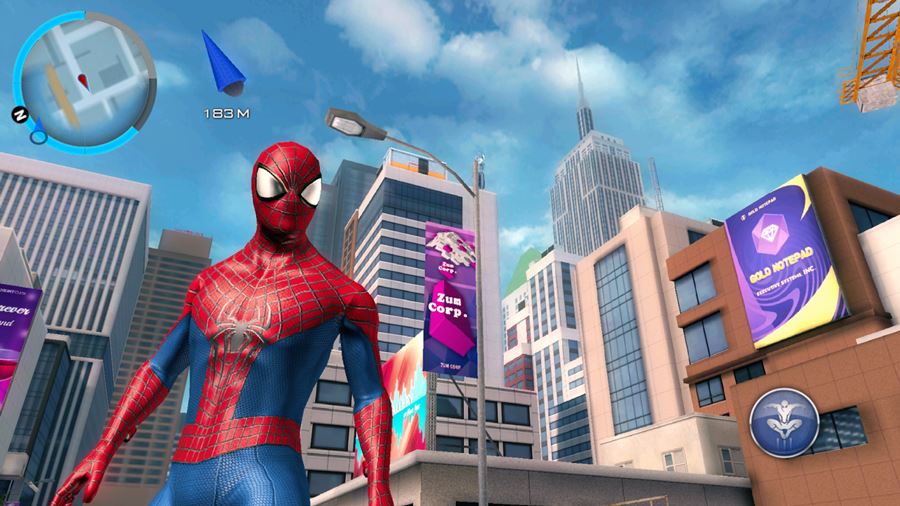
One of RedMemories’ most impressive works is the recovery of The Amazing Spider-Man 2, a game released by Gameloft in 2014.
According to the developer, more than 46 thousand functions of the original engine were converted ahead of time into native 64-bit code, allowing the game to work as a modern application.
The campaign, the city, and the missions remain the same as in the original version. However, the adaptation received important improvements:
- Execution on 64-bit Android smartphones;
- Native screen resolution, with 4x antialiasing;
- Graphics configured at the highest quality profile;
- Sharper textures and improvements in the visualization of scenarios;
- 60 FPS rate, instead of the original 30 FPS;
- Interface fixes for modern screens;
- Offline operation, without depending on the old Gameloft services.
Another interesting detail is that the developer took advantage of higher-resolution textures present in the iPhone version, improving the appearance of characters, clothes, buildings, and various elements of the scenery.
The adaptation also removed old license checks and buttons that directed to Gameloft services that have already been shut down.
The project can be followed on the GitHub of The Amazing Spider-Man 2 Revived.
Batman: The Dark Knight Rises also works again

Another recovered classic is The Dark Knight Rises, an open-world game released by Gameloft in 2012, inspired by the movie Batman: The Dark Knight Rises.
In this case, the developer claims to have recompiled 39,153 of the 39,158 functions of the original engine for 64 bits.
The work went beyond recompilation. RedMemories explains that the old copy he found had been modified by a third-party store, which inserted advertising and ended up corrupting part of the application’s Java code.
To solve the problem, it was necessary to rebuild much of the game’s Android structure, using another version as a reference.
The result is an adaptation that preserves Gotham City, the missions, and the original story, but works in full screen and with performance close to 60 FPS, according to the developer’s own tests.
The documentation also states that the game has already been tested on a Galaxy S26 Ultra equipped with Android 17.
The project is documented in the The Dark Knight Rises Revived repository.
Spider-Man: Total Mayhem can reach 120 FPS

Perhaps one of the most curious results is that of Spider-Man: Total Mayhem, an action game released by Gameloft in 2010.
RedMemories claims to have converted 19,089 of the 19,096 functions of the original engine into 64-bit code, keeping the scenarios, enemies, and the campaign.
In addition, the adaptation allows the title to run at up to 120 FPS on 120 Hz screens, without speeding up the game’s original speed.
Adjustments were also made to the virtual controls, which now make better use of the edges of modern screens, and improvements in the handling of old textures.
This is important because certain compression formats used by 2010 games are no longer directly recognized by some current GPUs.
To work around this limitation, the project decodes the textures during loading, allowing them to be used on modern smartphones.
The code and information about the adaptation are available on the GitHub of Spider-Man: Total Mayhem Revived.
Mass Effect Infiltrator and the first Amazing Spider-Man were also recovered

Not all RedMemories projects use exactly the same technique.
In the case of Mass Effect Infiltrator, released in 2012 by Electronic Arts, the developer uses a 64-bit application that dynamically translates the code of the original engine.
The result preserves the combat, the story, and the scenarios, but adds native resolution, image improvements, and offline operation.
According to the documentation, the game can reach 60 FPS and already works even on certain smartphones with MediaTek Dimensity, Exynos, and Google Tensor processors, in addition to devices with Snapdragon.
One curiosity is that RedMemories also brought Mass Effect Infiltrator to Windows, using ARM-to-x86-64 code translation, in addition to support for Xbox controllers, keyboard, and mouse.
The work is available in the Mass Effect Infiltrator Revived repository.
Meanwhile, the first The Amazing Spider-Man, also released in 2012, uses dynamic translation of the old code inside a 64-bit application.
The adaptation received graphical improvements, fixes for ultrawide screens, and support for Bluetooth and USB controllers, taking advantage of the commands originally developed for the Xperia Play.
The developer also modified the game to work without depending on Gameloft’s online services.
More information is available on the GitHub of The Amazing Spider-Man Revived.
Modern Combat 4 and Spider-Man Unlimited are also on the list

In addition to the projects mentioned, RedMemories’ GitHub profile features repositories dedicated to other classic Android games.
Among them are Modern Combat 4: Zero Hour, one of Gameloft’s most popular FPS games, and Spider-Man Unlimited, an endless runner Spider-Man game that was officially shut down.
The ModernCombat4Revived and SpiderManUnlimitedRevived repositories appear among the developer’s recent activities in November 2026.
However, the development stage and the availability of working versions may vary from one project to another. The presence of a repository does not necessarily mean that a complete adaptation is already ready.
What are the requirements to run these games on Android 16 and 17?
One of the best pieces of news is that these adaptations do not necessarily require the latest version of Android.
In projects with documented requirements, RedMemories states that the minimum system is Android 10, as long as the smartphone has a 64-bit environment.
Storage requirements vary depending on the game:
- The Amazing Spider-Man: approximately 2.5 GB free;
- The Amazing Spider-Man 2: approximately 3 GB free;
- The Dark Knight Rises: approximately 3 GB free;
- Spider-Man: Total Mayhem: approximately 1 GB free;
- Mass Effect Infiltrator: approximately 1.2 GB free.
The developer reports tests on a Galaxy S26 Ultra with Android 16 and Android 17, depending on the game and the version used.
It is important to highlight that not all ports have had their compatibility verified on different processors. Although some already support GPUs from other manufacturers, several tests are still concentrated on devices with Snapdragon.
Therefore, operation may vary depending on the phone model, the graphics drivers, and the installed version of the operating system.
Where to find the RedMemories projects?
The developer maintains a public profile on GitHub, where he gathers technical information, screenshots, and updates about his mobile game preservation work.
Access the RedMemories profile on GitHub.
The projects are independent and have no official link with Gameloft, Electronic Arts, Marvel, or Warner Bros.
Although the repositories describe adaptations and installation procedures, the original games remain protected by copyright. The public availability of a preservation project does not amount to authorization from the rights holders to redistribute the commercial files.
It is also advisable to verify the origin of any unofficial APK before installing it, especially when it is distributed outside app stores.
A new way to preserve the history of mobile games
RedMemories’ work draws attention because it addresses a problem that directly affects the history of mobile games.
Unlike consoles, which frequently receive collections of classics and official re-releases, many old mobile games simply disappeared with operating system updates.
This is especially frustrating because current smartphones have enough power to run these titles with much higher quality than the devices of the time.
The obstacle is not necessarily the lack of performance, but the incompatibility between old software and modern platforms.
By recompiling 32-bit engines, adapting libraries, and rebuilding components that stopped working, projects like RedMemories demonstrate that there is still room to recover part of this catalog.
If similar initiatives continue to advance, classics that marked the generation of the first Android smartphones may work again on modern devices, preserving an important part of the history of mobile games.
Post Relacionados:
 The Best YUZU Games for Android (Compatible and smooth Games)
 25 Best shooter games for Android 2023
 25 Best OFFLINE Racing Games for Android and iOS
 How to Play EVERY FALLOUT Games on Android
 Top 15 Best Metroidvania Games for Android and iOS 2025
 100 Old Android and iOS Games That Marked Your Childhood


