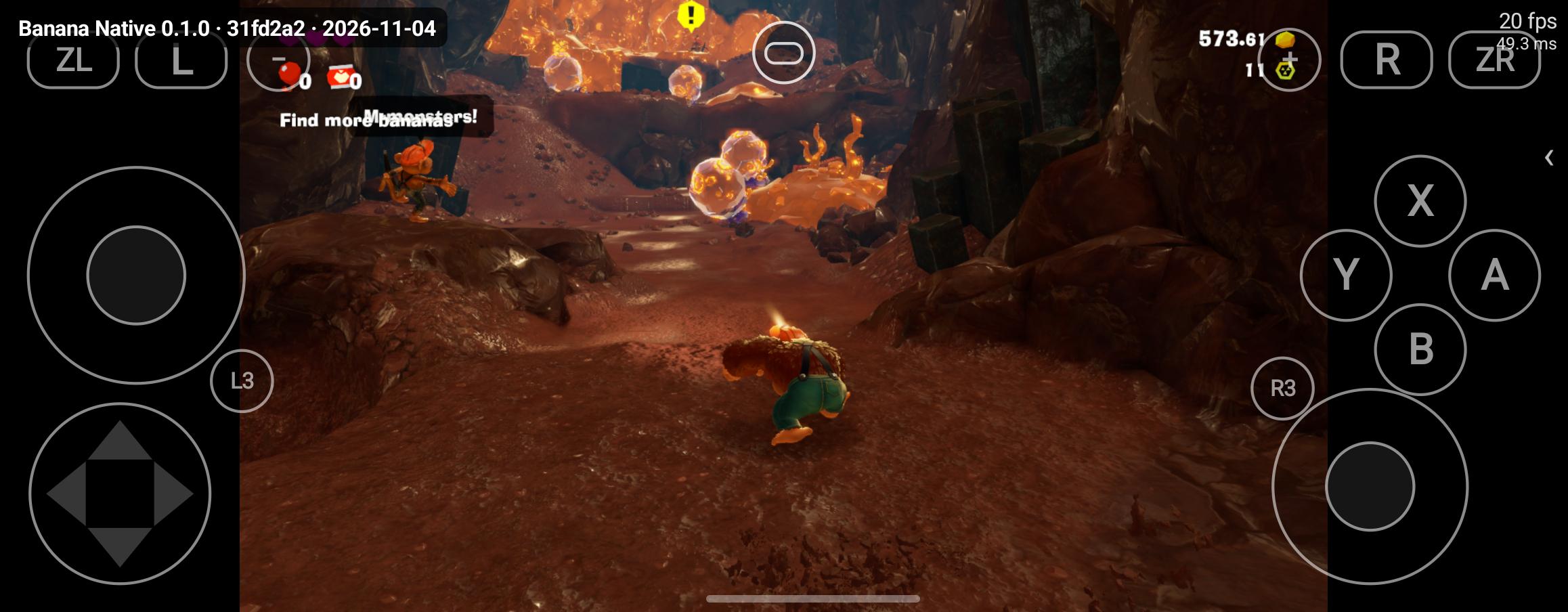
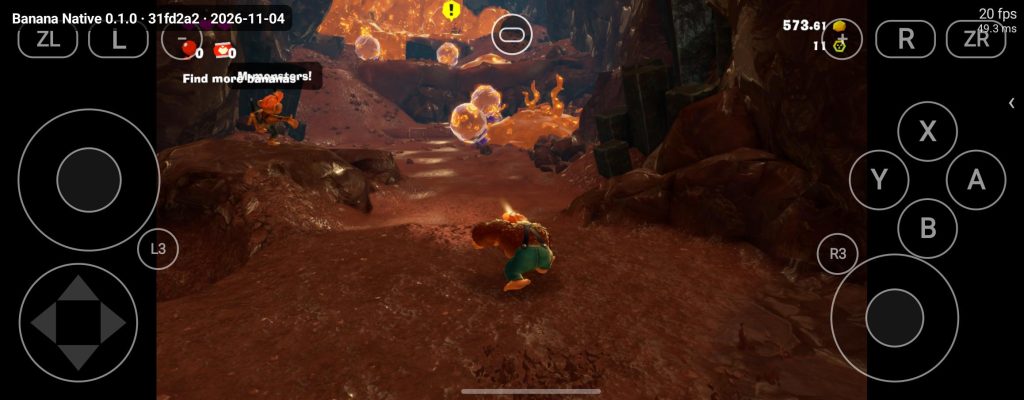
Donkey Kong Bananza, one of the main exclusive games for the Nintendo Switch 2, has just received an unofficial native port for Android. The Nintendo game, released in July 2025, is already running on smartphones thanks to the Banana Native project, which uses adaptation and code recompilation techniques to run titles from the new console directly on phone processors.
The news is impressive because we are talking about one of Nintendo’s most recent and technologically advanced games. Donkey Kong Bananza was developed especially for the Switch 2, with largely destructible three-dimensional environments, detailed graphics, and a large number of interactive elements.
The project is developed by a programmer known as moceure, who also worked on the experimental Eden SX2A, a Nintendo Switch 2 emulator for Android.
This time, however, the approach is different. Instead of using traditional emulation, Banana Native takes advantage of the ARM64 architecture shared between the Switch 2 and modern smartphones to run the game’s code directly on the phone’s processor.
Donkey Kong Bananza running nativity on android
byu/Cultural-Move-9748 inAndroidNativePorts
Donkey Kong Bananza for Android works without traditional emulation
Banana Native is an Android adaptation of the nxnative project, originally developed for Apple devices such as iPhone, iPad, and Mac computers.
The main difference compared to conventional emulators lies in the way the game’s code is executed.
Normally, an emulator needs to reproduce various console components, including operating system services, memory management, and graphics functions. Depending on the architecture, translation of processor instructions may also be required.
Banana Native uses another approach. Since the Nintendo Switch 2 and the latest Android smartphones use ARM64 processors, the program can run much of the original code directly on the device’s CPU.
During preparation, the game’s modules are modified to work in the Android environment, while the graphics commands of the NVN API, used by Nintendo, are adapted to the Vulkan API.
The project also implements the services needed to replace certain functions of the Switch 2 operating system.
Video from the Emulação Android Channel:
In practice, the result is a native port based on the game’s original code, without the need to emulate a Nintendo Switch 2 CPU.
It is important to note that the technology does not correspond exactly to the traditional static recompilation used in older game projects. Banana Native rewrites parts of the modules and prepares the shaders to work directly on Android, maintaining native execution of ARM64 instructions.
Donkey Kong Bananza already runs at 30 FPS on Android
The first tests were performed on a smartphone equipped with a Snapdragon 8 Elite Gen 5, 16 GB of RAM, and Adreno GPU.
According to the results released by the developer, Donkey Kong Bananza can already run at 1080p resolution, presenting approximately 30 frames per second during much of the gameplay.
In certain situations, the rate can rise to values close to 60 FPS, but the project still has performance limitations related to the processing of graphics commands.
The documented results are as follows:
- Snapdragon 8 Elite Gen 5 with Qualcomm driver: approximately 30 FPS, with sections between 55 and 58 FPS;
- Snapdragon 8 Elite Gen 5 with Turnip driver: approximately 30 FPS, with sections between 49 and 59 FPS;
- Resolution: 1080p profile adapted for smartphones;
- RAM of the tested device: 16 GB.
These results were obtained without artificial frame generation. The developer states that he intends to optimize processing to achieve 60 FPS more consistently in future updates.
One of the features already available in Banana Native is integration with the Lossless Scaling frame generation system.
With this feature, it is possible to use image interpolation to achieve outputs of 60, 90, or even 120 FPS from a lower frame rate.
However, these additional frames are artificially generated and do not represent an equivalent increase in the game’s actual performance. The technology can also introduce visual artifacts and increase input latency.
Port already allows exploring the environments of Donkey Kong Bananza
The adaptation can already run the game and present its three-dimensional environments, allowing the player to control Donkey Kong and explore the scenarios.
Donkey Kong Bananza is a platform and adventure game in a three-dimensional world that places Nintendo’s famous gorilla on a journey through the depths of a gigantic underground world.
Accompanied by Pauline, Donkey Kong must cross different regions, face enemies, find treasures, and discover the mysteries of the underground.
The big highlight of the gameplay is environmental destruction. Donkey Kong can break walls, tear pieces from the terrain, open tunnels, and modify the scenery with his attacks.
These mechanics require a lot of processing, since the game must continuously handle changes in the geometry of the environments.
Therefore, seeing Donkey Kong Bananza running on an Android smartphone is an especially interesting result for the port community.
Despite the advances, the adaptation is not yet fully optimized. The developer reports problems with some textures during battles and small stutters on the first execution of certain areas while the shaders are being prepared.
Smartphone heating can also cause performance drops after prolonged periods of play.
Banana Native is also trying to run Mario Kart World
Donkey Kong Bananza is not the only Nintendo Switch 2 exclusive being adapted by the project.
The developer has also started testing Mario Kart World, another game released especially for Nintendo’s new console.
According to the documentation, Mario Kart World can already start matches and allow the player to control the vehicles, but it still presents important graphical problems.
Among the known defects are missing textures, flickering trees, and areas of the scenery that may appear completely black.
Memory consumption is also high, even on smartphones with 16 GB of RAM.
For now, Donkey Kong Bananza is the main functional example of the technology used by Banana Native.
Which phones can run Donkey Kong Bananza?
The project is still in an experimental stage and has high requirements.
According to the developer, Banana Native requires:
- Operating system: Android 13 or higher;
- Processor: Qualcomm Snapdragon with Adreno GPU;
- RAM: at least 12 GB;
- Device used in tests: Snapdragon 8 Elite Gen 5 with 16 GB of RAM;
- Graphics drivers: original Qualcomm drivers or compatible versions of Turnip;
- Game files: your own compatible copy of Donkey Kong Bananza.
The developer recommends using an external cooler to control heating during prolonged sessions.
It is also important to note that the tests released so far were performed mainly on a single smartphone. Therefore, it is not yet possible to guarantee operation on other processors or phone models.
How to download the Donkey Kong Bananza port for Android?
Banana Native is available for free on GitHub and has already received several updates since its first public version.
On November 5, 2026, the developer released version 0.1.4, which adds an update system through the app itself and improvements in memory management.
To use the project, you need to install the official Banana Native APK and prepare the files from a compatible copy of the game.
The program does not include the commercial data of Donkey Kong Bananza. It works as an environment that prepares and runs the game’s code on Android.
Currently, the compatible version of Donkey Kong Bananza is the update identified as 458752. Using other versions may not work correctly.
The file preparation process can be performed directly on the smartphone, although it takes approximately one hour. There is also the possibility of using a Mac computer to prepare the data, reducing this time to about 10 to 15 minutes.
Check out the official links:
Download Banana Native APK for Android (GitHub)
Official Banana Native repository and instructions
The developer warns that GitHub is the only official distribution channel for the project. APKs found on other websites may have been modified and do not offer the same guarantees of origin.
It is worth remembering that Banana Native is an independent initiative, with no connection to Nintendo, and does not distribute game files, encryption keys, or Switch 2 firmware.
Native ports could change the future of gaming on Android
The emergence of Banana Native shows how the community is rapidly advancing in running modern games on smartphones.
Until recently, most recompiled port projects for Android involved titles from older consoles, such as Nintendo 64, PlayStation 2, and Xbox 360-generation platforms.
Now, the possibility of running games originally developed for the Nintendo Switch 2 demonstrates the potential of the ARM64 processors used by current phones.
This does not mean that any game from the new console can be automatically converted to Android. Each title has specific dependencies, different graphical resources, and its own memory and processing needs.
However, the fact that Donkey Kong Bananza is already running is an important advance for this technology.
If developers can improve compatibility, reduce memory consumption, and optimize graphics commands, native ports could become an increasingly interesting alternative to traditional emulation.
For now, Donkey Kong Bananza for Android remains an experimental project, but the first results show that even Nintendo Switch 2 exclusives can find new ways to run on smartphones.